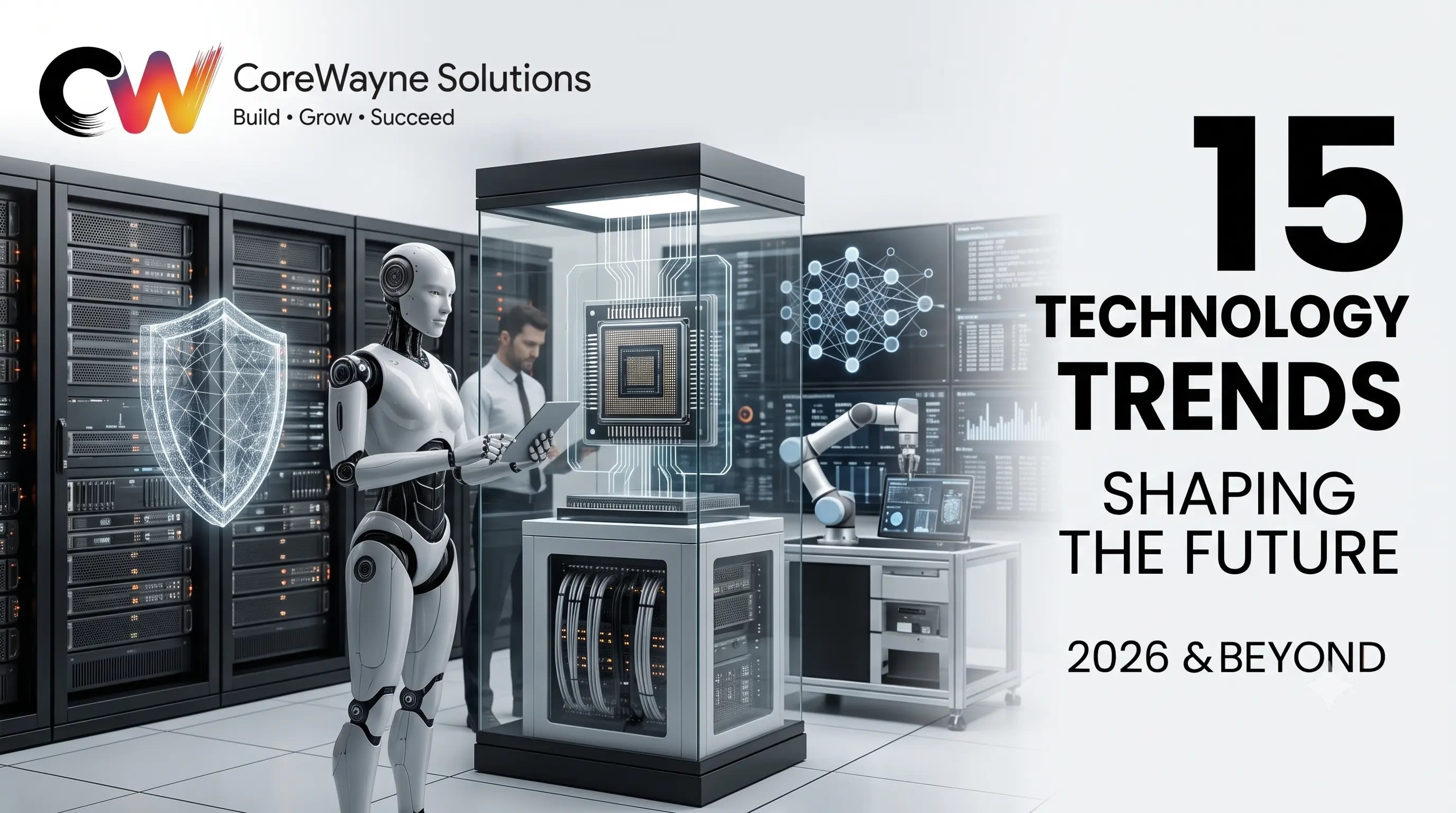
Technology is changing faster than ever. Artificial intelligence is moving from simple chatbots toward increasingly capable agents, software development is becoming more AI-assisted, robots are becoming more intelligent, cybersecurity is becoming more proactive, and quantum computing continues to move toward practical applications.
For businesses, developers, students and technology enthusiasts, understanding these changes is becoming increasingly important. The technologies being developed today could influence how we work, communicate, build software, protect information and operate businesses throughout the coming decade.
In this guide, we explore 15 technology trends that could have a major impact in 2026 and beyond.
Why Technology Trends Matter in 2026
Technology is no longer evolving in isolated categories. Artificial intelligence is increasingly connected with cloud computing, cybersecurity, robotics, software development, healthcare, manufacturing and communication networks.
This convergence is creating a technology ecosystem where multiple technologies work together.
1. Agentic AI
Generative AI changed how people create text, images, code and other digital content. The next major development is increasingly capable agentic AI.
Instead of simply responding to a prompt, an AI agent can be designed to plan tasks, use tools, interact with software and complete multiple steps toward a goal.
For businesses, this could mean automating repetitive workflows such as customer support, research, reporting, scheduling and data processing.
2. Multi-Agent AI Systems
Rather than relying on one AI system for every task, organizations may increasingly use specialized AI agents that collaborate.
A digital workflow could include research, marketing, sales, finance, customer support and software-development agents working together.
This approach could make complex AI workflows easier to automate and manage.
3. AI-Native Software Development
AI is becoming part of the software-development lifecycle, supporting coding, debugging, testing, documentation, code review and application design.
The developer's role is therefore increasingly focused on architecture, verification, security, problem solving and product thinking.
4. AI-Powered Cybersecurity
AI is becoming increasingly important to both attackers and defenders. Security teams are using automation and intelligent analysis to detect suspicious activity, investigate incidents and respond faster.
Organizations will need to protect websites, servers, APIs, credentials, data, AI models and automated workflows.
5. AI Security Platforms
As organisations deploy more AI applications and agents, centralised AI security becomes increasingly valuable.
Important areas include prompt-injection protection, data-loss prevention, access control, agent permissions, model monitoring, activity logging and policy enforcement.
6. Physical AI and Intelligent Robotics
Physical AI brings artificial intelligence into machines that interact with the real world.
This includes humanoid robots, industrial robots, autonomous vehicles, drones, warehouse robots and intelligent manufacturing systems.
These systems combine AI, computer vision, sensors, robotics and real-time decision-making.
7. Quantum Computing
Quantum computing uses fundamentally different approaches to processing information and could eventually provide advantages for certain specialized problems.
Potential applications include drug discovery, materials science, optimization, cryptography, scientific simulation and financial modelling.
Quantum computers are not expected to replace everyday computers. Instead, they are more likely to complement classical computing for specialized workloads.
8. Post-Quantum Cryptography
Advances in quantum computing are also increasing interest in post-quantum cryptography.
Organizations handling sensitive information over long periods should consider cryptographic inventories, migration strategies and crypto-agility as part of long-term security planning.
9. Confidential Computing
Confidential computing focuses on protecting sensitive information while it is being processed, often through hardware-based trusted execution environments.
This can be particularly valuable for financial services, healthcare, government systems, AI workloads and enterprise cloud environments.
10. Edge AI
Edge AI allows AI processing to happen closer to where data is generated, including smartphones, cameras, vehicles, industrial devices and IoT systems.
Benefits can include lower latency, improved privacy, faster responses and reduced dependence on remote cloud processing.
11. AI PCs and On-Device AI
AI capabilities are increasingly being integrated directly into laptops, smartphones and other personal devices.
Local AI can support transcription, image processing, video enhancement, personal assistants and privacy-focused AI features.
12. Digital Provenance
As AI-generated text, images, audio and video become increasingly common, verifying the origin and history of digital content becomes more important.
Digital provenance can help organizations establish greater trust in digital media, documents and other digital assets.
13. Domain-Specific AI Models
General-purpose AI models are powerful, but many organizations need systems specialized for particular industries or tasks.
Domain-specific AI can be developed for areas such as healthcare, finance, law, education, manufacturing, cybersecurity and software engineering.
14. AI and Cloud Infrastructure
AI workloads are changing cloud infrastructure requirements.
Modern AI infrastructure increasingly depends on accelerators, GPUs, high-speed networking, specialized storage, model-serving platforms and inference optimization.
15. AI-Powered Digital Transformation
The most important trend may not be a single technology but the combination of technologies.
AI + Cloud + Cybersecurity + Data + Automation + APIs + Software + Analytics can create integrated digital systems that improve everyday business operations.
Technology Trends at a Glance
| Technology | Potential Impact |
|---|---|
| Agentic AI | Automates multi-step workflows |
| Multi-Agent Systems | Enables specialized AI collaboration |
| AI-Native Development | Accelerates software development |
| AI Cybersecurity | Improves threat detection and response |
| AI Security | Protects AI applications and agents |
| Physical AI | Brings intelligence into machines |
| Quantum Computing | Targets specialized computing problems |
| Post-Quantum Cryptography | Prepares security for quantum threats |
| Confidential Computing | Protects data during processing |
| Edge AI | Moves AI processing closer to devices |
| On-Device AI | Enables local AI capabilities |
| Digital Provenance | Improves digital trust |
| Domain-Specific AI | Provides specialized AI capabilities |
| AI Cloud Infrastructure | Supports large-scale AI workloads |
| Digital Transformation | Combines technology to improve businesses |
Which Technology Will Have the Biggest Impact?
There may not be one single winner. The biggest transformation is likely to come from the convergence of technologies.
AI agents need cloud infrastructure. Cloud systems need cybersecurity. Robots need AI and edge computing. Quantum computing may create new security requirements. Businesses need software capable of connecting these systems.
What Should Businesses Do Today?
- Identify repetitive work that could be automated.
- Improve digital infrastructure before adding complex AI systems.
- Secure business data and applications.
- Test AI tools that provide measurable productivity improvements.
- Train employees to work effectively with AI.
- Monitor emerging technologies without blindly adopting every trend.
- Build flexible systems that can integrate new technologies later.
What Will Technology Look Like in 2030?
AI is likely to become increasingly integrated into software, devices and business operations. Robotics may become more capable in controlled environments, cybersecurity may become increasingly automated, and computing may move dynamically between cloud, edge and local devices.
The biggest change may be that technology becomes less visible. Instead of opening separate applications for every task, people may increasingly interact with intelligent systems that coordinate multiple services in the background.
The Future Belongs to People Who Adapt
Technology changes the skills people need. Developers need AI-assisted development skills. Marketers need to understand AI-powered search and automation. Business owners need to understand digital transformation. Security professionals need to understand emerging AI threats.
The most valuable skill may be the ability to learn, adapt and solve problems using new technology.
Final Thoughts
The technology landscape of 2026 is moving toward a world where artificial intelligence, automation, cloud computing, cybersecurity, robotics and emerging computing technologies increasingly work together.
The future of technology will be defined by how intelligently we combine technologies to solve real problems.
Businesses should not chase every trend. The better strategy is to build a strong digital foundation that can evolve as technology changes.
Frequently Asked Questions
What are the biggest technology trends in 2026?
Major trends include agentic AI, multi-agent systems, AI-native software development, AI cybersecurity, physical AI, quantum computing, edge AI, confidential computing and AI infrastructure.
What future technology should businesses watch?
AI agents, physical AI, quantum computing, AI security and specialized AI models are among the technologies worth monitoring because of their potential impact across industries.
Will AI replace software developers?
AI is automating many development tasks, but software engineering still requires architecture, testing, security, product understanding and human judgment. The role of developers is evolving rather than simply disappearing.
Will quantum computers replace normal computers?
No. Quantum computers are expected to complement classical computers and focus on specialized problems.
Should small businesses invest in emerging technology?
Small businesses should prioritize technologies that solve measurable problems. AI automation, modern websites, cybersecurity, cloud services and data-driven digital marketing can often provide more immediate value than experimental technologies.
What technology skills will be important in the future?
AI literacy, cybersecurity, software development, data analysis, automation, cloud computing, critical thinking, problem solving and continuous learning are likely to remain valuable.
Build for the Future With CoreWayne
Technology is changing rapidly, but businesses do not have to navigate the change alone.
CoreWayne helps businesses build modern digital solutions through website development, e-commerce development, SEO, digital marketing, AI solutions and technology services.
Whether you are starting a new business, modernizing an existing website or exploring AI-powered automation, the right digital foundation can help your business adapt to what comes next.